デヴィッド・G・ヴァン・アーナム
Copyright c 1963
Copyright c 1963
翻訳:Hide
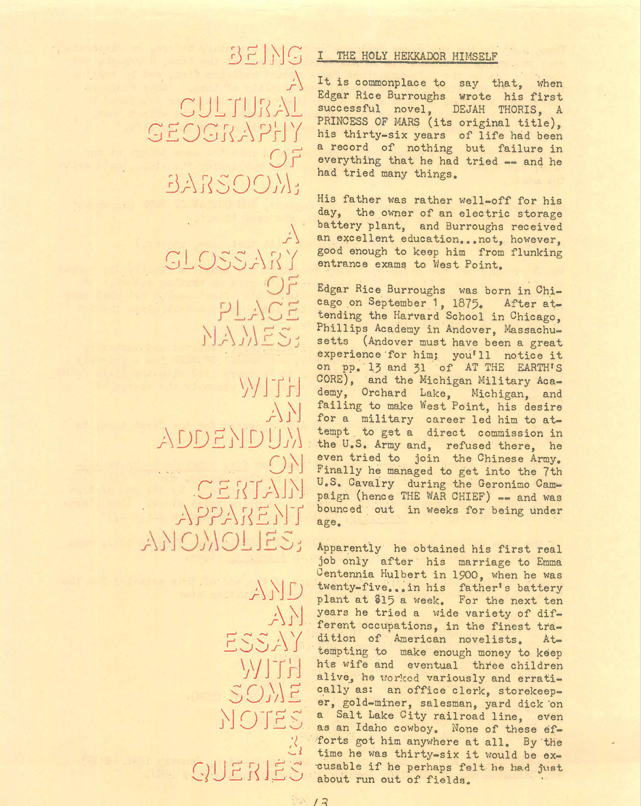
| It is commonplace to say that, when Edgar Rice Burroughs wrote his first
successful novel, DEJAH THORIS, A PRINCESS OF MARS (its original title),
his thirty-six years of life had been a record of nothing but failure in
everything that he had tried — and he had tried many things. His father was rather well-off for his day, the owner of an electric storage battery plant, and Burroughs received an excellent education... not, however, good enough to keep him from flunking entrance exams to West Point. Edgar Rice Burroughs was born in Chicago on September 1 , 1875. After attending the Harvard School in Chicago, Phillips Academy in Andover, Massachusetts (Andover must have been a great experience for him; you'll notice it on pp. 13 and 31 of AT THE EARTH’S CORE), and the Michigan Military Academy, Orchard Lake, Michigan, and failing to make West Point, his desire for a military career led him to attempt to get a direct commission in the U.S, Army and, refused there, he even tried to join the Chinese Army. Finally he managed to get into the 7th U.S. Cavalry during the Geronimo Campaign (hence THE WAR CHIEF) — and was bounced out in weeks for being under age. Apparently he obtained his first real job only after his marriage to Emma Centennia Hulbert in 1900, when he was twenty-five... in his father’s battery plant at $15 a week. For the next ten years he tried a wide variety of different occupations, in the finest tradition of American novelists. Attempting to make enough money to keep his wife and eventual three children alive, he worked variously and erratically as: an office clerk, storekeeper, gold-miner, salesman, yard dick on a Salt Lake City railroad line, even as an Idaho cowboy. None of these ef forts got him anywhere at all. By'the time he was thirty-six it would be excusable if he perhaps felt he had Just about run out of fields. Then, much in the way James Fenimore Cooper had a century before, he discovered what was going on around him in the writing game. At the time, Burroughs was checking ads in the pulp-magazines for a patent medicine firm, and in reading the stories was struck by the overall poor quality of them. James Fenimore Cooper was reported to have said, on reading the stories being published in England on the Indians in the late colonies, something to the effect that, "Hell, I can do better than that and I never wrote a word in my life." I think we can safely agree that Burroughs said much the same thing; at any rate, the effect was the same. Magazines were publishing the stuff, he’d write the stuff. He tossed off a historical novel about England, THE OUTLAW OF TORN (in which an early Lord Greystoke is briefly seen), and sent it off. Unfortunately, it failed to get published. (At that time, anyway.) But Burroughs had not given up trying to get in the Army (he finally did become an officer in the Illinois Militia), and didn’t give up writing either. A vanity press in Nev; York claims they published his "first book," but what book this is, I do not know. And he is said to have ghosted a book along the How To Succeed In Business line, god help us. Then Thomas Newell Metcalf, the editor of All-Story, received and instantly accepted a manuscript called DEJAH THORIS, A PRINCESS OF MARS for a princely $400. Run as a six-part serial beginning in February 1912 with the title UNDER THE MOONS OF MARS, it changed Burroughs' life, and probably the course of science fiction. Three issues after MOONS, TARZAN OF THE APES appeared for the first time, in the pages of the October 1912 All-Story. Burroughs had found a career. The next year saw five complete books in All-Story and New-Story: two more Mars novels, another Tarzan, and THE CAVE GIRL and A MAN WITHOUT A SOUL (THE MONSTER MEN, in book form). By the end of that year, 1915, he was making $20,000 a year in magazine sales alone. (And starting in the January 1914 New-Story, OUTLAW made its appearance at last.) By the time McClurg brought out A PRINCESS OF MARS in book form in 1917, some 18 Burroughs novels had been serialized in All-Story alone. A more complete bibliography will be found at the end of this article; for the time being, the Mars Books in order of book publication are: 1. A PRINCESS OF MARS, McClurg, 1917 (PM) 2. THE GODS OF MARS, McClurg, 1918 (GM) 5. THE WARLORD OF MARS, McClurg, 1919 (WM) 4. THUVIA, MAID OF MARS, McClurg, 1920 (TMM) 5. THE CHESSMEN OF MARS, McClurg, 1922 (CM) 6. THE MASTER MIND OF MARS, McClurg, 1928 (MMM) 7. A FIGHTING 1-AA1I OF MARS, Metropolitan Books, 1931 (FMM) 8. SWORDS OF MARS, Burroughs, 1936 (SwM) 9. SYNTHETIC MEN OF MARS, Burroughs, 1940 (SMM) 10. LLANA OF GATHOL, Burroughs, 1948 (LG) and two shorter stories: 11. JOHN CARTER AND THE GIANT OF MARS, Amazing Stories, January 1941 (JCGM) 12. SKELETON MEN OF JUPITER, Amazing Stories, February 1943 (SMJ) The numbers are as used in the Glossary; the abbreviations are from Heins' magnificent bibliography* and are used in page citations within the body of the article; and in the text I.use the obvious short form of each title. NOTE: Most of my page references (but see my bibliography) are for the Methuen (British) editions, which vary slightly from the American; for THUVIA, CHESSMEN, and MASTER MIND, however, I used the Dover one-volume edition with continuous pagination. |
エドガー・ライス・バローズが、自身の最初の成功作となった小説『火星の王女デジャー・ソリス DEJAH THORIS, A PRINCESS
OF MARS』(初期タイトル)を執筆した当時、彼の36年間の人生は、ありとあらゆる試みにおいて失敗の連続であったと言われている。実際、彼は実に様々なことに挑戦してきたのだ。 彼の父親は当時としてはかなり裕福で、蓄電池工場を経営していた。バローズは恵まれた教育を受けたが、それでも陸軍士官学校(ウェストポイント)の入学試験に合格することはできなかった。 エドガー・ライス・バローズは1875年9月1日、シカゴで生まれた。シカゴのハーバード・スクール、マサチューセッツ州アンドーバーのフィリップス・アカデミー(アンドーバーでの経験は彼にとって非常に大きなものだったはずだ。そのことは『地底世界ペルシダー』の13ページや31ページからも読み取れる)、そしてミシガン州オーチャード・レイクにあるミシガン陸軍士官学校を経て、ウェストポイントへの入学に失敗した彼は、軍人としての道を諦めきれず、アメリカ陸軍への直接任官を試みた。それが叶わないと知ると、なんと中国軍への入隊まで考えたという。最終的に、「ジェロニモ討伐作戦」の最中にアメリカ第7騎兵連隊に入隊することができたものの(この経験が『ウォー・チーフ』の着想につながった)、年齢が足りなかったために、わずか数週間で除隊させられてしまった。 彼が初めてまともな職に就いたのは、1900年、25歳の時にエマ・センテニア・ハルバートと結婚してからのことである。彼は父親の蓄電池工場で働き、週給15ドルを得ていた。その後10年間、彼はアメリカの小説家によく見られる伝統に倣うかのように、実に様々な職業を転々とした。妻と、やがて生まれる3人の子供を養うための稼ぎを得ようと、事務員、店員、金鉱掘り、セールスマン、ソルトレイクシティの鉄道警備員、さらにはアイダホ州のカウボーイなど、多種多様な仕事を不安定に渡り歩いたのである。しかし、こうした努力のどれ一つとして、彼に成功をもたらすことはなかった。 36歳になる頃には、もう挑戦できる分野が尽きてしまったと感じたとしても、それは無理からぬことだっただろう。 そんな折、1世紀前のジェイムズ・フェニモア・クーパーがそうであったように、彼は当時の出版業界で何が起きているのかを目の当たりにする。当時、バローズはパルプ・マガジンに掲載されていた特許薬の広告をチェックする仕事をしていたのだが、その雑誌に載っている物語のあまりの質の低さに衝撃を受けた。ジェイムズ・フェニモア・クーパーも、かつてイギリスで出版された、植民地時代の先住民を題材にした物語を読んだ際、「くそっ、これくらいなら俺にだって書ける。これまで一度も文章を書いたことがない俺にでもな」といった趣旨のことを言ったと伝えられている。 バローズもほぼ同じことを言ったと考えて間違いないだろう。いずれにせよ、結果は同じだった。雑誌社がそうした作品を掲載しているのなら、自分も書いてやろう、というわけだ。 彼はイギリスを舞台にした歴史小説『トーンの無法者(The Outlaw of Torn)』(この作品には、グレイストーク卿の先祖らしき人物がちらりと登場する)を書き上げ、投稿した。 あいにく、それは出版には至らなかった。(少なくとも、その時点では。) だが、バローズは軍への入隊を諦めてはおらず(最終的にはイリノイ州民兵隊の将校となった)、執筆活動もやめなかった。ニューヨークの自費出版業者が、彼の「最初の本」を出版したと主張しているが、それが具体的にどの本を指すのかは定かではない。また、なんと『ビジネスで成功する方法』といった類の本のゴーストライターを務めたという話もある。やれやれ、といったところだ。 その後、『オール・ストーリー(All-Story)』誌の編集者トーマス・ニューウェル・メトカーフが、ある原稿を受け取り、即座に掲載を決定した。その作品は『火星の王女デジャー・ソリス Dejah Thoris, A Princess of Mars』というタイトルで、原稿料は当時としては破格の400ドルだった。1912年2月から『火星の月の下で Under the Moons of Mars』というタイトルで全6回にわたって連載されたこの作品は、バローズの人生を、そしておそらくはSFというジャンルの歴史をも変えることとなった。 『火星の月の下で』の連載終了から3号後、1912年10月号の『オール・ストーリー』誌に、初めて『類猿人ターザン Tarzan of the Apes』が登場した。 こうして、バローズは自らの天職を見出したのである。翌年には、『オール・ストーリー』誌および『ニュー・ストーリー』誌に5作の長編小説が掲載された。その内訳は、『火星』シリーズの続編2作、『ターザン』シリーズの1作、そして『石器時代へ行った男 The Cave Girl』と『魂のない男 A Man Without a Soul』(単行本化の際は『モンスターマン The Monster Men』と改題)である。1915年末の時点で、彼は雑誌掲載料だけで年間2万ドルの収入を得ていた。(なお、1914年1月号の『ニュー・ストーリー』誌からは、『トーンの無法者』の連載もついに開始された。) 1917年にマクラーグ社から『火星のプリンセス』が単行本として刊行された時点で、バローズの小説は『オール・ストーリー』誌だけでも約18作が連載されていた。 より詳細な著作リストは、本稿の末尾に掲載する。現時点において、「火星」シリーズの各作品を出版順に並べると以下の通りであり。 1. 『火星のプリンセス』(火星の王女:A PRINCESS OF MARS)、マクラーグ社、1917年 (PM) 2. 『火星の女神イサス』(火星の神々:THE GODS OF MARS)、マクラーグ社、1918年 (GM) 3. 『火星の大元帥カーター』(火星の軍神:THE WARLORD OF MARS)、マクラーグ社、1919年 (WM) 4. 『火星の幻兵団』(火星の乙女スビア:THUVIA, MAID OF MARS)、マクラーグ社、1920年 (TMM) 5. 『火星のチェス人間』(訳題同様:THE CHESSMEN OF MARS)、マクラーグ社、1922年 (CM) 6. 『火星の交換頭脳』(火星の天才:THE MASTER MIND OF MARS)、マクラーグ社、1928年 (MMM) 7. 『火星の秘密兵器』(火星の闘士:A FIGHTING MAN OF MARS)、メトロポリタン・ブックス社、1931年 (FMM) 8. 『火星の透明人間』(火星の剣豪:SWORDS OF MARS)、バローズ社、1936年 (SwM) 9. 『火星の合成人間』(訳題同様:SYNTHETIC MEN OF MARS)、バローズ社、1940年 (SMM) 10. 『火星の古代帝国』(ガソールのラナ:LLANA OF GATHOL)、バローズ社、1948年 (LG) および、短編2作: 11. 『火星の巨人ジョーグ』(ジョン・カーターと火星の巨人:JOHN CARTER AND THE GIANT OF MARS)、『アメイジング・ストーリーズ』誌、1941年1月号 (JCGM) 12. 『木星の骸骨人間』(訳題同様:SKELETON MEN OF JUPITER)、『アメイジング・ストーリーズ』誌、1943年2月号 (SMJ) 番号は「用語集(Glossary)」で使用されているものに従っている。また、略称はハインズによる素晴らしい書誌目録に基づいている。また、本文中でのページ参照については、各タイトルの簡略化した表記を用いている。 注:ページ参照の大部分はメシュエン社(英国)版に基づいている(参考文献一覧も参照のこと)。同版は米国版とは若干異なる。ただし、『幻兵団(Thuvia)』、『チェス人間(Chessmen)』、『交換頭脳(Master Mind)』の3作については、通しページ番号が振られたドーバー社版の合本版を使用した。 |
comment
同じような文章を厚木さんの解説などで何度目にしたことか。これが原典だとわかるわけで、訳しなおす甲斐はあるか。